




Ryan Wedding’s Network Linked To Toronto's Growing Police Corruption Scandal
TORONTO — Brian Da Costa, the central narco-trafficking suspect in an explosive Toronto police corruption case — one that allegedly enlisted serving officers to traffic drugs and to help target a jail official for murder — has been connected to Gurpreet Singh, the Indo-Canadian trucker that U.S.
 open.substack.com
If Department of War is cleaning out cartels, they have to come north, too.Brian Da Costa, the central narco-trafficking suspect in an explosive Toronto police corruption case — one that allegedly enlisted serving officers to traffic drugs and to help target a jail official for murder — has been connected to Gurpreet Singh, the Indo-Canadian trucker that U.S. prosecutors describe as a key cross-border smuggler in the billion-dollar cocaine trafficking network of former Olympian turned Sinaloa Cartel heavyweight Ryan Wedding.
The connection appears on a bail no-contact list, drawing the clearest line yet between the highest-profile police corruption scandal in modern Canadian history and the networks of Wedding, and by extension the Sinaloa and Jalisco cartels.
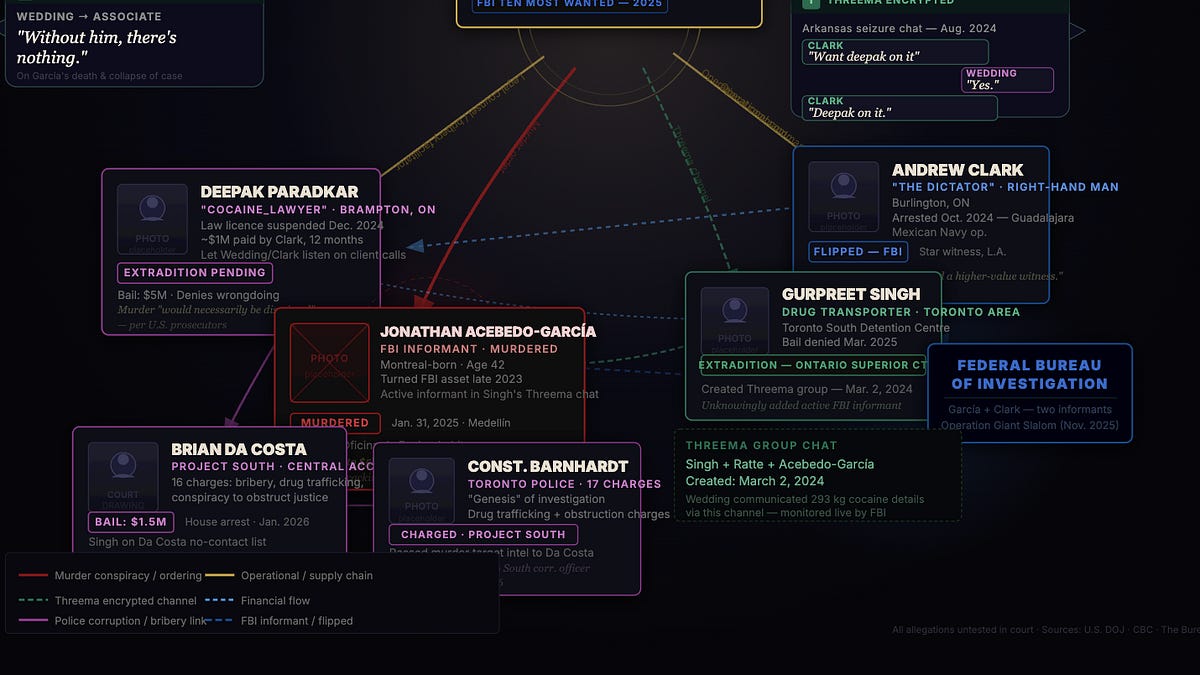
A review of the first indictment against Wedding shows that Singh, Wedding’s co-accused, was part of a tight circle of cartel operatives communicating over encrypted channels — a command layer that included Jonathan Acevedo-García, the U.S. federal witness later allegedly executed on Wedding’s orders. Deepak Paradkar was also allegedly part of that circle, and is now charged in the second American indictment with counselling the murder of Acevedo-García, facilitating bribery, and penetrating Canadian police systems on the cartel’s behalf.
The newly disclosed connection between Da Costa — facing 16 charges in an expanding corruption probe described by some police veterans as among the gravest in Canadian history — and Gurpreet Singh gives those broader corruption concerns new urgency. It also raises pointed questions about how deeply Canada’s law enforcement, courts, and criminal underworld have become entangled with transnational fentanyl, cocaine, and methamphetamine supply chains.
The bail conditions that put Singh on Da Costa’s no-contact list were first reported by CBC from filings made public in Ontario court documents this week. Singh is one of 35 individuals Da Costa cannot contact as a condition of his $1.5 million release.
Wedding was arrested in Mexico City in January by Mexican state forces operating with support from U.S. counter-terror and military-intelligence units.
The overlap between Da Costa and Wedding is indirect, but court filings and prior U.S. government source interviews allow the relationship to be reconstructed.
Wedding climbed above all competitors in Canada’s organized crime landscape — outlaw biker-type narco cells — by forging alliances with Mexican cartel members and Iranian underground bankers, and came to dominate the supply of cocaine and methamphetamine into Canada from Latin America.
The pipeline moved product northward through Indo-Canadian mafia and trucking networks. Gurpreet Singh was allegedly a key node in that structure, one of Wedding’s most trusted Indo-Canadian trucking contacts. Deepak Paradkar, a Brampton, Ont., lawyer who allegedly counselled Wedding to murder Jonathan Acebedo-García, is also accused of setting up bribes, penetrating an Ontario Provincial Police investigation, and introducing Wedding to the Indo-Canadian narco-trucking networks, according to the Wedding II federal witness murder indictment.
More recent U.S. government filings accuse Paradkar of “reaffirming” the “belief” in conversations with Wedding and a co-operating witness that the FBI’s case was “no longer viable” after the January 2025 killing of the Quebec-based convicted fentanyl trafficker, turned FBI informant, Jonathan Acebedo-García.
The Toronto police corruption case suggests Da Costa was a central Ontario-based trafficker within that same narco ecosystem. His network is alleged to have sought the murder of a senior corrections officer at Toronto South Detention Centre — reportedly because the official was proving highly effective at blocking drugs from entering the facility.
Da Costa was arrested on January 23, 2026, and granted $1.5 million bail under house arrest. Police allege he ran a sophisticated trafficking operation spanning cocaine importation, methamphetamine distribution, and the export of cannabis and fentanyl — a pound of fentanyl seized at his arrest was believed bound for Europe. Four officers — Const. Timothy Barnhardt, Sgt. Robert Black, Const. Saurabjit Bedi, and Sgt. Carl Grellette — are alleged to have accepted bribes from Da Costa to protect illegal cannabis dispensaries from police enforcement. Barnhardt faces numerous drug trafficking counts; Black faces cocaine trafficking; Bedi faces conspiracy to traffic. Seven serving officers and one retired constable have been charged in total.
When asked directly whether the conspiracy to murder a corrections officer was connected to the networks of Ryan Wedding — whose organization, according to U.S. government filings, was involved in bribing Canadian officials — York Regional Police said they could not respond.
The court filings can.
Singh is named as a defendant in the first superseding indictment in United States v. Ryan James Wedding, filed in September 2024 and unsealed the following October, which charged 16 individuals in connection with bulk cocaine shipments to Canada. According to American prosecutors, Singh and his uncle, Hardeep Ratte, operated a Canada-based drug transportation network that moved cocaine from Southern California stash houses northward on behalf of Wedding’s organization. The two men allegedly negotiated the arrangement — at a rate of $220,000 per truckload — at a meeting held in a Brampton, Ontario auto body shop. The meeting was secretly recorded by an undercover informant working with the Federal Bureau of Investigation.
That informant was Jonathan Acebedo-García — a Canadian-Colombian man, Montreal-born, who had turned FBI asset in late 2023 after serving time for fentanyl trafficking in Quebec. When Gurpreet Singh created a Threema encrypted group chat on March 2, 2024, adding himself, Ratte, and Acebedo-García to coordinate cocaine shipments, he did not know he was placing an active federal informant inside Wedding’s operational command channel, the U.S. filings suggest.
Through that same channel, according to American prosecutors, Wedding communicated through that channel about the movement of 293 kilograms of cocaine across the border — confirming shipment details, passing authentication tokens, and narrating the mechanics of the supply pipeline to a man whose every word was being relayed to the Federal Bureau of Investigation.
Prosecutors allege Singh and Ratte co-ordinated at least two cocaine shipments totaling more than 650 kilograms for the enterprise. According to CBC’s reporting, Singh has been held at Toronto South Detention Centre since his October 2024 arrest. This is the same facility that Da Costa’s Toronto police-facilitated network allegedly sought to import drugs into — and conspired to murder the jail official who was blocking the shipments.
A bail application was denied in March 2025. His extradition proceedings are ongoing before the Ontario Superior Court of Justice. Brian Greenspan, Singh’s lawyer, confirmed to the CBC that his client faces charges only in the United States, but declined to say whether investigators had made contact with him or his client in relation to the Project South investigation.
The scale of what American authorities say Wedding built over the years he operated from Mexico took years to come fully into view. U.S. authorities allege his organization routinely moved hundreds of kilograms of cocaine from Colombia, through Mexico and Southern California, to Canada and other American destinations, using stash houses and long-haul semi-trucks as part of a bulk-shipment pipeline. Bureau sources with knowledge of the American investigation have said Wedding’s success depended in part on leveraging cross-border trucking enterprises tied to Indo-Canadian criminal networks — and on the persistent failure of Canadian law enforcement and the courts to mount an effective response.
One senior U.S. investigator, speaking to The Bureau for an earlier exclusive report on Wedding’s rise, described the Cancún region as “a haven for Canadian organized crime — mid- to high-level drug dealers coordinating with Mexican counterparts to bring stuff into Canada.” The investigator offered a terse summary of how Wedding distinguished himself among the Canadians drawn to Mexico’s cartel economy. “I think he just rose above all of that. Whether it was through violence or just the people he knew, Wedding became the single point of contact for any Canadian who wanted to bring drugs back up into Canada from Mexico.”
That investigator’s account of Canada’s institutional response was less measured. “We tried to work with RCMP on Wedding too, and they said, ‘No,’” the source said, drawing on knowledge of probes from three separate U.S. agencies. “He’s killed God knows how many. But the RCMP threw up roadblocks. Just in the Greater Toronto Area alone, people were falling once a week. Especially when the heat was getting closer to this guy, he started killing all the people he knew. And I think there were seriously missed opportunities.”
The same 46-page record of the case reviewed by CBC News, consistent with U.S. government source information previously reported by The Bureau, also points to Wedding operating as a conduit for not one but two of Mexico’s most powerful cartels.
After Toronto police announced the city’s largest-ever drug bust in January 2025 — $83 million worth of cocaine — Paradkar was hired to defend some of those charged, according to the U.S. filing. Investigators at the time linked that seizure to the Jalisco New Generation Cartel, designated a terrorist organization by both the U.S. and Canadian governments. Mexican authorities have also linked the Jalisco cartel to Wedding’s network. One senior U.S. government official, whose assessment The Bureau has previously reported, went further. “This is my own assessment — that there’s not any serious drug-trafficking activity in Canada that happens without Ryan Wedding’s network being part of it.”
The second and more sweeping U.S. indictment — unsealed in November 2025 as part of what officials called Operation Giant Slalom — alleges that Wedding and his organization went to extraordinary lengths to protect themselves once Acebedo-García’s role as an informant was discovered. According to American prosecutors, Deepak Paradkar, charged in the indictment under the alias “cocaine_lawyer,” advised Wedding and his top lieutenant, Andrew Clark, that if Acebedo-García was killed, the federal charges and extradition proceedings against them “would necessarily be dismissed.”
A 46-page record of the case reviewed by CBC News reveals the depth of Paradkar’s alleged financial entanglement with the cartel: Clark paid Paradkar approximately $1 million in a 12-month period for various services, compensated through bulk cash drops and expensive watches. Paradkar is also accused of allowing Wedding and Clark to listen in on conversations with his own clients who were members or associates of the drug trafficking organization. Paradkar allegedly did not stop there. He is accused of obtaining confidential OPP Project Midnight disclosure — the joint OPP-Peel Regional Police investigation into the Caledon murders — and relaying photographs of that evidence to Clark through the same Threema encrypted channel.
The Caledon killing had occurred in November 2023. Wedding and Clark had ordered an assassination of a truck driver they believed had stolen a 300-kilogram cocaine load. The killers entered the wrong address. The couple inside — Jagtar Sidhu, 57, and Harbhajan Sidhu, 55 — were shot dead. Their daughter was wounded. The couple had travelled from India to visit their children, who had come to Canada as international students.
Wedding placed a bounty of up to $5 million US on Acebedo-García after learning he had become a federal witness, and authorized a multinational manhunt that stretched from Medellín to Montreal to Mecca. He paid $18,500 US for commercial spyware to track Acebedo-García’s cellphone — technology deployed numerous times in Canada and Mexico, including against a Montreal phone number tracked in real time, CBC has reported.
A Colombian network of cartel-connected sex workers gathered Acebedo-García’s movements on the ground. Canadian associates identified his contacts. A Montreal-area man hired to locate him eventually traveled to Saudi Arabia and declined the murder contract when it was offered, though he still received $40,000 Canadian for his efforts. The killers who ultimately carried it out were professional: one motorcyclist conducted advance reconnaissance, one shooter fired five rounds into Acebedo-García’s head while he ate at a restaurant in Medellín on January 31, 2025, two others handled the getaway, and a photographer cased the restaurant in advance and documented the body afterwards.
Within minutes, Wedding used Threema to send Clark a photograph of the dead man. A Mississauga man who operated a Canadian urban media website called the Dirty News then posted what U.S. prosecutors describe as a celebratory account of the killing, calling Acebedo-García “one of the informants involved in dismantling Ryan ‘Snowboarder aka SB’ Wedding’s transnational organization” and claiming bounties had been placed on every individual who had co-operated.
Wedding’s calculation — that the murder had extinguished the prosecution — was stated plainly in his own encrypted messages. “Without him, there’s nothing,” he wrote to an associate in June 2025, months after Acebedo-García’s death, insisting the FBI’s case had collapsed. He was wrong. Clark, his second-in-command and alleged operational partner in the murder conspiracy, had been arrested by the Mexican navy in October 2024 in the Guadalajara area and had by then turned FBI informant himself. Clark, a former Burlington, Ontario resident, is expected to testify against Wedding at trial in Los Angeles. The hit on Acebedo-García, designed to save the enterprise, had produced a higher-value witness from within its own command layer.
The bail filing linking Brian Da Costa to Gurpreet Singh adds another layer to an increasingly urgent portrait emerging from the courts: Mexican cartel networks penetrating not only Canada’s drug economy, but also its police services, legal profession, and courts.
By extension, the Da Costa case, with its fentanyl exportation charges, begins to surface questions not yet confronted in Canadian courtrooms about the extent of Wedding’s involvement in the spread of Mexican cartel-linked fentanyl labs across the country.
Upvote
4