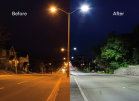


JÄGER: We all hate ridiculously bright headlights — why not restrict them?
Once illuminated by a pleasant warm glow, our streets are now filled with vehicles whose blazing white lamps are powerful enough to burn the retinas of every other driver, pedestrian, and cyclist in their sights.
A great idea, so nothing will come of it. So tired of being blinded.Unless you live under a rock, you'll undoubtedly have noticed that headlights are brighter than they used to be — and not just by a little.
Once illuminated by a pleasant warm glow, our streets are now filled with vehicles whose blazing white lamps are powerful enough to burn the retinas of every other driver, pedestrian, and cyclist in their sights.
How did we get here? Who woke up one morning and decided drivers needed to see into the future at the expense of everyone around them?
Well, it all started in the early 2000s when manufacturers began replacing halogen bulbs with LEDs. While the former fall on the yellow-ish orange end of the colour temperature scale, the latter sit at the other extreme, appearing white, almost blue. Compared to halogens, LEDs are far more energy efficient, and have a longer lifespan — which is great if you're trying to cut costs and brand yourself as environmentally friendly.
Before long, LEDs became the standard — the brighter the better.
Lawmakers in Europe and other parts of the world quickly responded to complaints from road users by permitting Adaptive Driving Beam technology, which dims headlights automatically when the vehicle senses others are near. Canada and the United States, on the other hand, only updated regulations to allow for ADB in 2018 and 2022, respectively.
According to the non-profit group Insurance Institute for Highway Safety, no North American models had the technology as of December 2024. Given that most manufacturers build cars for the whole continent, few drivers in Canada will have access to the technology until our neighbours to the south catch up.
Even then, that will only solve part of the problem; if every new car is sold with ADB, the roads will still be filled with those sporting the glaring white LEDs.
Then there's the issue of drivers themselves.
During his seven years as a car salesman in British Columbia and Alberta, Kyle saw first-hand how little the average person knows about the lights in their vehicle.
In an interview with the Western Standard, he explained that while headlight technology is improving, drivers typically don't know how to engage it, or what to do if it turns off or malfunctions. He noted that in most cases, as long as the dealer says the car has it, people think it just automatically comes on and works, thus many drive around blissfully unaware that they're beaming their lights directly into the eyeballs of other drivers.
Kyle added that new cars with uninformed owners are only one part of the problem, and that in many cases, aftermarket headlights are to blame.
He recalled living and working in Grand Prairie, where many truck drivers installed third-party lamps either for better visibility or aesthetic reasons and — willfully or otherwise — opted not to adjust the beam accordingly.
"Half the people out there don't even know that's a thing," Kyle lamented, "or they do and don't want to pay for it."
He said many had a mentality of "I'll lift my truck, it doesn't matter if it's facing the wrong way or a little bit up or anything like that, you're just going to have to deal with it because I'm in my big truck."
In light of all the aforementioned factors, some have argued that the only option is for government to step in and regulate. As of now, Transport Canada's Lighting System and Retroreflective Devices regulations do not place any limit on brightness. Among those calling for action at the federal level is Vancouver City Councillor Sean Orr. On Wednesday, his motion to combat "excessively bright vehicle headlights" passed unanimously.
"The proliferation of oversized vehicles with elevated headlight mounting heights, combined with brighter factory-installed and aftermarket headlights, has intensified glare impacts, especially on lower vehicles and active transportation users," his motion read.
"Headlight glare has been linked to reduced night-time visibility, delayed reaction times, increased collision risk, and particular harm to seniors, people with astigmatism or other vision impairments, cyclists, and pedestrians."
According to a 2024 study conducted by the Royal Dutch Touring Club, 78% of road users said they were "regularly or always blinded by the bright lights of other road users." Over 20% described it as "unbearable," while 71% said it was simply "annoying."
Nearly three-in-four respondents said they "look away" when faced with bright headlights, while 60% squint, and just 10% continue staring in that direction. Research has indicated that it can take up to nine seconds for our eyes to recover from glare.
Orr's motion will now be submitted by the city to the Federation of Canadian Municipalities for consideration at the next annual conference. It calls on the federal government to do three things:
1. Establish clearer and enforceable limits on headlight brightness, beam pattern, and mounting height.
2. Strengthen oversight of adaptive and high-intensity lighting technologies.
3. Improve regulation and enforcement related to non-compliant aftermarket vehicle lighting.
Kyle argued that while noble in concept, in practice it would be hard to implement.
"I don't think you'll ever solve headlights in people's mirrors because there's cars that are lower and there's cars that are higher," he explained, "and even if you change regulations, it's either cops randomly pulling people over, or it's going to take 10 years for enough people to have the new cars with those new lights."
Kyle also noted that, in general, manufacturers are more interested in passing their safety checks and not getting sued than appeasing those annoyed by bright lights. He noted that because the Canadian and US markets are so intertwined, limits to brightness on either side of the border would hurt automakers, thus they're "not gonna fight to have different regulations."
Regardless of whether anything comes of the city's move, we can all do our part to avoid blinding one another. Learn more about your car's headlights and how they work, and be courteous next time you're on the road. Seriously, nobody needs their hi-beams on in the middle of the day...
Upvote
18