

View: https://x.com/markjcarney/status/2078574791821492595?
What's the (free speech) deal with Canada?
Canada is steadily transforming free expression from a right into a privilege — one that regulators, tribunals, and government officials can withdraw whenever they decide another interest matters more
 eternallyradicalidea.com
For all my fellow haters.First, the categorical safe harbor is gone — so whether a sermon or a quoted verse is protected now depends on context, audience, and how a prosecutor reads the room. Second, in the horse-trading that got the bill through Parliament, the government also dropped the longstanding requirement that the Attorney General personally sign off before a hate-speech charge can proceed. In the absence of these two barriers, clergy and ordinary believers now get to wonder, in advance, whether saying the quiet part of their faith out loud will be read as hatred by someone with the power to charge them.
American law has a name for what happens when people must guess what they are allowed to say and, because of the uncertainty, end up not saying anything at all: a chilling effect. We have little doubt Canadians will feel that chill, even in wildfire season.
There’s more. Close behind the Combatting Hate Bill, a new Ottawa bylaw taking effect August 1 will mandate a 50-meter “bubble zone” (that’s about 164 freedom feet) around schools, hospitals, places of worship, daycares, and care homes. Inside the bubble, protest is simply banned. Not “protest that blocks the door,” or “protest that disrupts planned events,” but any protest at all. A councillor actually proposed narrowing the mandate to only prohibit conduct that actually obstructs access, and the motion lost. The Canadian Civil Liberties Association, Canada’s analogue to the ACLU, warned that two people standing on a sidewalk reading a pamphlet about peace would now be in violation of this bill. This is an intentionally broad blanket ban on expression that was once protected in Canada.
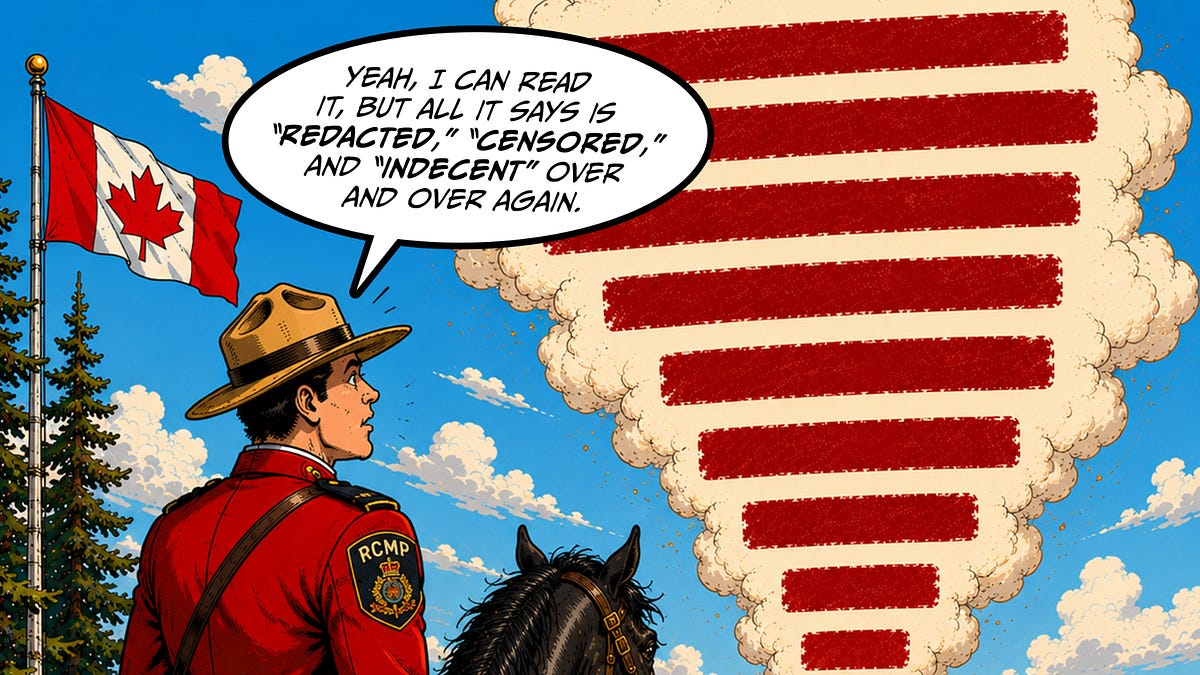
There’s more. In early July, Canadians learned of a 35-page internal memo from Industry Minister Mélanie Joly’s department — titled “Misinformation and Disinformation Strategy” — floating “legal action” against users on Facebook, X, and LinkedIn who post what the government deems “false and misleading information.” What action, exactly? Beats us. That part’s redacted. The visible portion assures everyone that whatever it is will be “documented, proportionate, and subject to senior level approval.” And don’t worry, the department itself would decide what counts as “factually incorrect, misleading or out of context.”
You read that right. This memo proposes giving the Canadian government the power to deem criticism false and punish (somehow?) the author for publishing that false information or the platform for hosting it — who exactly would be the target of “legal action” is also unclear. If that sounds familiar, it should. The Soviet Union had something very much like it. And if it strikes you as bizarre that Canada is doing this, we’re with you. Giving the government power to determine what is misinformation functionally gives it control of truth itself. Every government makes mistakes, and every government has incentives to conceal those mistakes, defend its policies, and discredit its critics. This policy and others show Canadian officials seemingly ignoring these very real risks.
By strange coincidence, kiwifarms seems to be down.
Upvote
22