




In Tense Ethics Hearing, Conservatives Say Brookfield Partnered With Vancouver Condo Developer 15 Days Before Carney's Bailout — and Call Brookfield as a Witness
OTTAWA — In a contentious ethics committee, Conservative MP Aaron Gunn moved Tuesday to summon Vancouver condo marketer Bob Rennie, federal Housing Minister Gregor Robertson, and major developers connected to Rennie’s fundraiser for Mark Carney as witnesses in an urgent parliamentary...
 open.substack.com
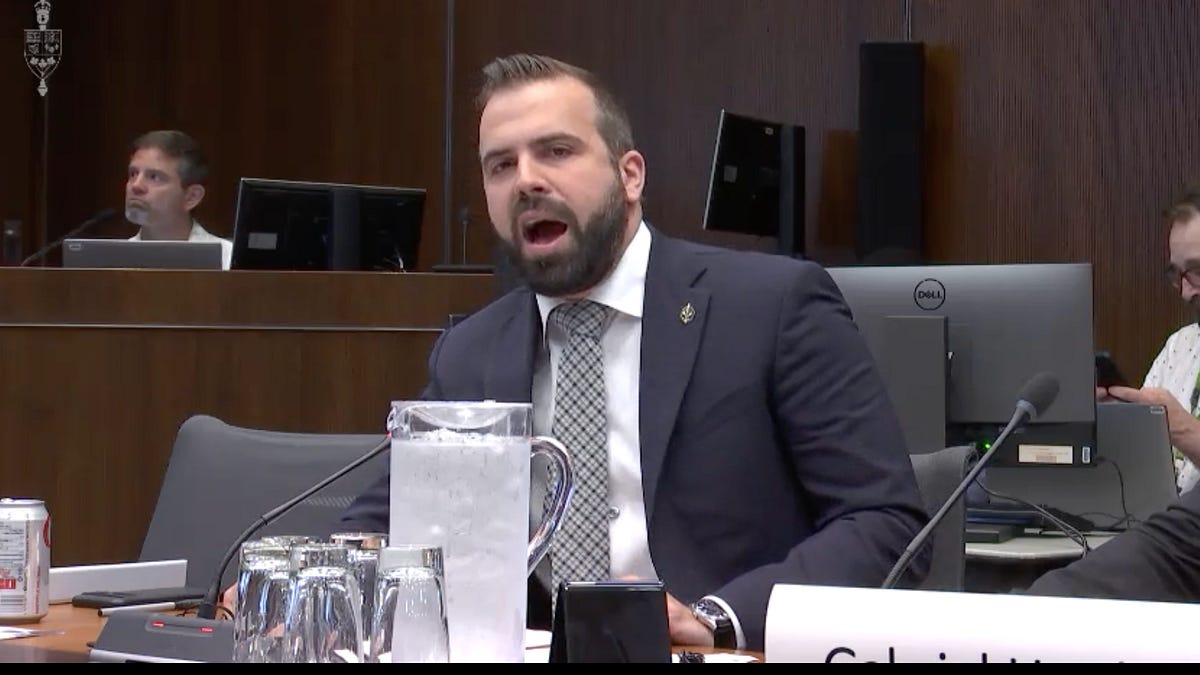
The clot thickens.In a contentious ethics committee, Conservative MP Aaron Gunn moved Tuesday to summon Vancouver condo marketer Bob Rennie, federal Housing Minister Gregor Robertson, and major developers connected to Rennie’s fundraiser for Mark Carney as witnesses in an urgent parliamentary investigation of the Prime Minister’s multibillion-dollar British Columbia condo bailout. A second Conservative, Gabriel Hardy, then walked the committee through a timeline that ended on the most pointed suggestion of the hearing.
Hardy asserted that Brookfield — the asset-management giant Carney chaired before entering politics — became co-owner in a deal with Concert Properties, a developer holding dozens of condo projects in the Burnaby glut zone, fifteen days before the bailout was announced.
Gunn’s motion, put to the Standing Committee on Access to Information, Privacy and Ethics, calls for no fewer than six meetings this summer into what the governments have styled the Canada–British Columbia partnership on condo conversion — the June 18 plan to buy more than 2,200 unsold Vancouver-region condominiums with public funds.
The witness list reaches from the political architects to the industry’s commanding heights: former Vancouver mayor and now Carney housing minister Gregor Robertson; British Columbia Housing Minister Christine Boyle; Vancouver Mayor Ken Sim; Rennie, whom the motion identifies as the figure “often called Vancouver’s Condo King”; Duncan Wlodarczak, chair of the Liberal Party of Canada in British Columbia and chief of staff at Onni Group, one of the province’s largest developers; the Urban Development Institute; Concert Properties; and Brookfield Asset Management. The motion further demands that both governments produce any agreement between them on the condo program, and any agreement between either government and any developer or lender, immediately upon finalization.
Gunn’s motion would put the bailout’s contracts — which developers, which units, at what price — before Parliament as they are signed, answering the questions the governments have so far declined to address.
It asserts that Carney’s plan would “bail out developers, bankers, and investors by using taxpayer dollars,” that it “will not make housing more affordable, but will prevent a price correction from taking place, preserving high prices for developers rather than lowering them for British Columbians trying to enter the housing market,” that “forcing home buyers to compete with their own tax dollars while raising housing prices for the benefit of developers is not in the interest of Canadians.”
The Liberals, he said, “never campaigned on spending more than a billion dollars in taxpayer money to give a handout to their wealthy developer friends.” The plan, he argued, means developers “wouldn’t have to lower prices and God forbid sell at a loss,” and raises “some pretty obvious ethical questions that I think deserve answers — such as, if the Liberals didn’t campaign on this policy, why are they suddenly deciding to pursue it now? Whose idea was it? Who lobbied for it? Is this being planned for more Canadian cities? And maybe most importantly, which well-connected developers, big banks and foreign investors stand to benefit the most?”
“I also have to point out how insane the generational inequity of this policy truly is,” Gunn added. “Handing out huge sums of money to developers who have made billions over the past 20 years, paid for with tax dollars by those who are still trying to enter the housing market for the very first time. It is yet another generational transfer of wealth that creates no new units of housing while rewarding those who built and priced condos that nobody could afford.”
Conservative member Gabriel Hardy followed, pressing the case for urgency before the money moves.
The announcement came June 18, two days before Parliament adjourned, for the purchase of 2,200 unsold condominiums at a per-unit cost Hardy placed near $660,000.
Hardy then laid out the timeline, beginning with the Rennie fundraiser The Bureau has reported on. “An evening with Carney,” he told the committee. “It cost $1,750 to meet Mark Carney, the prime minister of Canada, in his office. No journalists — that’s often what happens, no journalists, behind closed doors. Don’t worry, our prime minister is full of virtue. But 17 main developers were there. And they all have one thing in common: thousands of condos unsold.” That was February 2026, Hardy said. In March 2026, he continued, a BC Housing document speaks to a meeting involving British Columbia’s housing minister. In May 2026, the Canada Mortgage and Housing Corporation reported a 76 percent surge in unsold completed condos in Metro Vancouver — concentrated, Hardy stressed, in Burnaby and Richmond. “Remember that,” he said, “because it’s important.”
Then came June 3. “Brookfield becomes co-owner” in a deal with Concert Properties involving eight industrial properties, Hardy told the committee — and he was careful with the distinction: “Just to be clear, the co-ownership is not for condos with Concert Properties.” But Concert, he noted, “has projects in the region, including 50 in Burnaby. Fifty condo buildings in Burnaby.” Fifteen days later came the bailout announcement. “For Brookfield, 15 days before the announcement, they are becoming co-owners with this condo company with thousands of condos that haven’t been sold,” Hardy said. “And then all of a sudden there’s announcements in cities and sectors that would interest Brookfield and in which Brookfield has made investments. Should we investigate? Yes.”
That, Hardy said, is why Concert Properties was named in the motion. “Concert Properties, who created a partnership with Brookfield 15 days before the announcement, will be among the developers from whom the government will be purchasing these condos in the fall. These are just facts. They’re not presumptions. They’re not accusations.” The prime minister, he noted, has said developers did not request the program from him directly.
Hardy then turned to the prime minister’s ethics screen — the conflict-of-interest wall meant to separate Carney from decisions touching Brookfield. The screen, Hardy told the committee, has been “activated 17 times. So these are direct employees of the prime minister who trigger this screen. So there are potential conflicts of interest.” The committee, he said, had shared eight documents on potential conflicts involving the prime minister. “For a year — and I’ve been here for a year — we’re seeing that things are shady with the prime minister,” Hardy said. He offered a pattern he said kept recurring: “The prime minister often finds a way to be involved in everything. And I’ll give an example. In Mirabel, there was an announcement for planes. 28 days earlier, Brookfield became co-owners of a business that needed planes desperately in Mirabel. The committee hadn’t been able to ask questions on that, because every time that we table a motion, we’re told that we’re conspiracy theorists.”
That, he said, is why Brookfield Asset Management sits on the witness list: “One might wonder — is it actually a coincidence that Brookfield is always around? These questions are legitimate, and we need to receive answers.” The government members, he said, “are doing everything that they can so that we don’t move forward... We were able to work in a certain way before they became a majority. And now, since they have the majority, they are ensuring that these investigations don’t happen.”
“Make no mistake,” New Democrat Jenny Kwan, appearing at the committee, added. “It is a bailout for developers, even though the prime minister wants to pass it off as affordable housing. No one is buying it. The prime minister admitted as much at the announcement. He said, quote, ‘Developers are stuck.’”
Kwan said she rarely agrees with her Conservative colleagues, but backs the argument for an ethics probe in this case. Carney’s framing of the plan, she said, “sounds like a board member from Brookfield Asset Management, rather than the prime minister.”
The government side’s response, through the meeting’s opening stretch, came as procedure rather than argument.
Before Gunn had finished reading his motion’s clauses, Liberal member Bardish Chagger raised points of order over the French translation of the motion and its distribution; further interventions questioned the speaking order and the room’s audio, forcing Gunn to restart his reading repeatedly. The chair, Conservative John Brassard, said “I know what you’re doing here. I know what you’re doing to disrupt the meeting and that’s fine. You can continue it because people are watching.”
One of the new Liberal members, Wade Chang — who intervened early Tuesday on the speaking order — represents Burnaby Central, part of the region where the unsold-condo glut is concentrated.
The witnesses Gunn seeks sit at the center of the proximity pattern The Bureau has documented. Rennie hosted “An Evening with Mark Carney” at his Vancouver offices in February — a fundraiser whose Elections Canada filing lists 146 attendees paying up to $1,775 each, among them at least 17 of the province’s leading developers and former premier Christy Clark. A number of those developers hold unsold inventory in the Vancouver region’s glut — the same distressed stock the program proposes to buy. British Columbia government records show a briefing note headed “Rennie Meeting” was opened for Premier David Eby’s office in the same month. On a Postmedia panel in March 2025, Rennie said he was “working with Carney” on a plan to let foreign buyers back into the condo market through a federally backstopped rental pool.
Upvote
1