




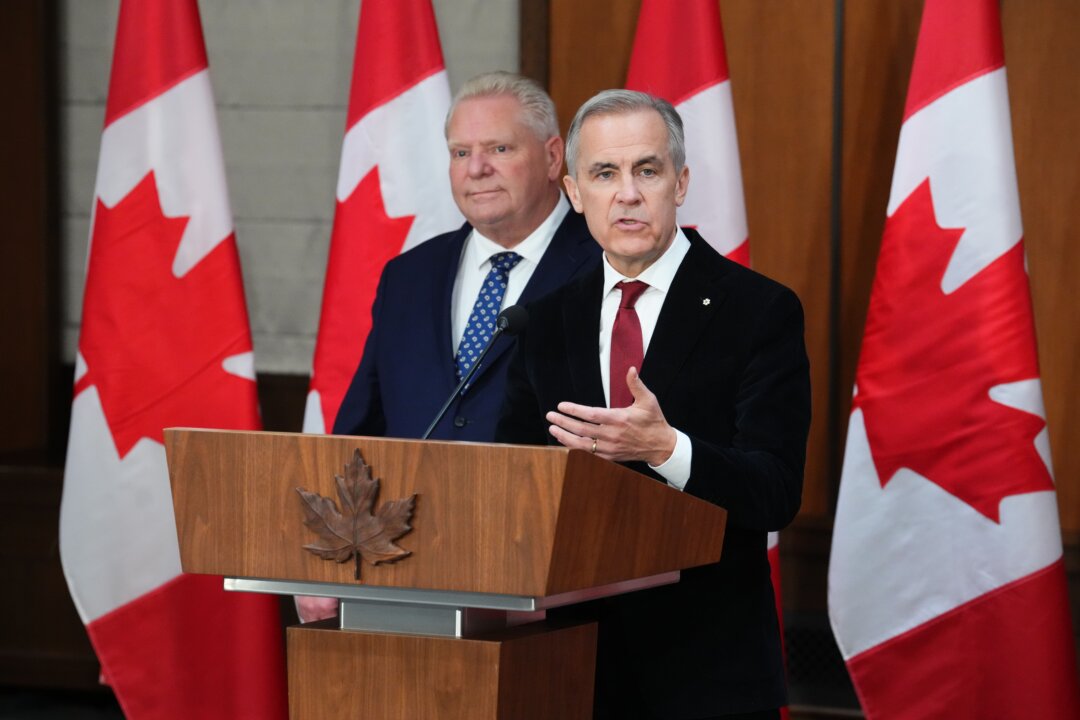

Prime Minister Mark Carney says Canada’s supply management system is off-limits in response to comments Dec. 17 from U.S. Trade Representative Jamieson Greer that the policy is one of the major roadblocks to reaching a Canada-U.S. trade deal.
Carney’s comments came in the context of media questions about when a U.S.-Canada sectoral deal can be reached, with Carney saying it’s “unlikely” that will happen before the joint review of the U.S.-Mexico-Canada Agreement (USMCA) next July.
“We'll continue to protect supply management,” Carney said Dec. 18 during an unrelated press conference in Ottawa alongside Ontario Premier Doug Ford. “Supply management is never on the table.”
Ford added that the issue is not relevant in any case, as the United States has not been exceeding its dairy product quota to Canada in recent years and thus hasn’t been subject to the triple-digit tariff rate that applies under the supply management system.
Canada’s supply management system establishes quotas for producers of dairy products, poultry, and eggs in order to control supply and prices. It also sets tariff-rate quotas for eggs, dairy products, and poultry imported into Canada in order to protect domestic producers from competition. The tariffs only kick in if imports to Canada cross a certain threshold.
Greer listed Canada’s dairy policies as one of the impediments to the United States renewing the USMCA during closed-door meetings with two committees in the U.S. Congress. He also said in remarks released Dec. 17 that Canada’s digital streaming regulations and provincial bans on U.S. alcohol are making the United States hesitate in renewing the USMCA.
Another six months of Elbows Up? Are their arms tired yet?Specifically on supply management, Greer said Canadian dairy rules “unfairly restrict market access for U.S. dairy products,” and go against the USMCA’s free-trade provisions.
Greer did not call on Canada to end its supply management program, but said that Canada must expand “market access for U.S. dairy” and stop the export of low-price Canadian dairy products into the United States if it wants Washington to renew the USMCA next July. Canada adjusted its quota system in favour of the United States in 2018 to give American producers more access as part of NAFTA renegotiations, since the Trump administration at that time had made it a condition to agree to the new USMCA. Ottawa allocated $3.9 billion in funding to compensate dairy farmers affected by the change in the quota system.
Further Issues
Speaking to Greer’s comments, Carney said the dairy supply management system being one of Canada’s non-negotiable items is not unusual, and cited 54 non-negotiable conditions set by Mexico from its side of trade negotiations with the United States.
Carney also said that the dairy supply management system and other Canadian policies raised by Greer are just one “subset of issues” from a broader conversation, and said he expects U.S. President Donald Trump to raise more sticking points with Canada.
Since failing to reach a deal with the United States by Aug. 1, Canada has faced a 35 percent tariff on all Canadian goods exported to the United States that aren’t covered under the USMCA, along with higher American sectoral duties on Canadian autos, steel, aluminum, copper, and softwood lumber.
Carney has consistently upheld the USMCA as being beneficial for Canada, stating that about 85 percent of Canadian goods cross into the United States tariff-free under the trade pact.
Discussions toward reaching a sectoral deal and renegotiating tariffs ground to a halt Oct. 23 after Ontario aired an anti-tariff ad in the United States that Trump said amounted to “election interference.”
Commenting on the ads Dec. 18, Carney said Washington and Ottawa had been “close” to a deal at the time, and rolled his eyes when Ford said the ad had been “the best ad ever.”
Carney added that Canada is still ready for a deal if the United States agrees to negotiate.
“It was the case that we were close to an agreement. We didn’t get that agreement. The terms of that agreement, from our perspective, are still on the table,” Carney said. “If the U.S. wanted to sit down this weekend, we could sit down this weekend and hammer out a sectoral deal. I’m confident of that from our side.”
However, Carney said that he feels it’s “unlikely” any trade deal will be reached before the joint review of the USMCA next July, saying it will likely “roll into the broader [USMCA] negotiations.”
Upvote
8


